
Ready to find out more?
EFMD Programme Accreditation FAQS
What is EFMD programme accreditation?
EFMD Programme Accreditation (EFMD Accredited) is a globally recognised quality assurance process that evaluates and benchmarks business and management education programmes. This accreditation signifies a commitment to excellence in curriculum design, teaching methods, student assessment, and quality assurance processes. It provides institutions with a comprehensive external validation of their programmes, fostering continuous improvement and adherence to international standards. Programmes undergoing the process benefit from enhanced visibility and competitiveness in the global education landscape. The accreditation system serves as a hallmark of academic quality, attesting to an institution's dedication to delivering impactful and innovative business education, thereby attracting top talent and facilitating meaningful partnerships with industry stakeholders.
What is the difference between membership and accreditation?
Membership with EFMD Global is a non-accreditation status that provides organisations with access to a network of business schools, management development consultancies and corporate learning organisations, as well as professional development opportunities, research, and other resources.
Accreditation with EFMD Global, on the other hand, is a formal process of evaluation and recognition of the highest quality of a business school. The accreditation process involves a comprehensive assessment of the school's curriculum, faculty and other aspects of the educational experience. Accreditation with EFMD Global indicates that a business school has met the organisation's rigorous standards of pedagogical and research quality and that its degrees are recognised as credible by employers and other stakeholders.
In summary, membership with EFMD Global is a way for organisations with an international outlook to participate in the network and access resources, while accreditation with EFMD Global is a formal recognition of the quality of a business school or programmes. Membership is a prerequisite for accreditation.
What is the difference between EQUIS and EFMD Programme Accreditation?
EQUIS and EFMD Programme Accreditation differ primarily in their scope and focus, with EQUIS assessing a business school's overall excellence, including its governance, programmes, internationalisation, ethics, and connections with the professional world at an institutional level. In contrast, EFMD Programme Accreditation (formerly EPAS) targets the quality and delivery of individual programmes, focusing on programme-specific achievements, design, and outcomes. Both accreditations serve complementary roles, fostering continuous improvement and strategic alignment across institutional and programme levels. EFMD Programme Accreditation can also be considered a stepping stone in an institution’s road to EQUIS. EQUIS-accredited schools can seek or retain their programme accreditations as part of their strategic development to further differentiate their programmes.
Institutions that achieve EQUIS accreditation are designated as "EQUIS-Accredited," while programmes that obtain EFMD Programme Accreditation receive the "EFMD-Accredited (+type of programme)” label.
What are the benefits of EFMD Programme Accreditation?
Please visit our EFMD Programme Accreditation Benefits page.
What is EPAS?
EFMD Programme Accreditation was formally called EPAS and rebranded in 2019. Please see the Global Focus article ‘EFMD Programme Accreditation: Past, present and future’ for a detailed explanation of the change.
How can I start the EFMD Accredited process?
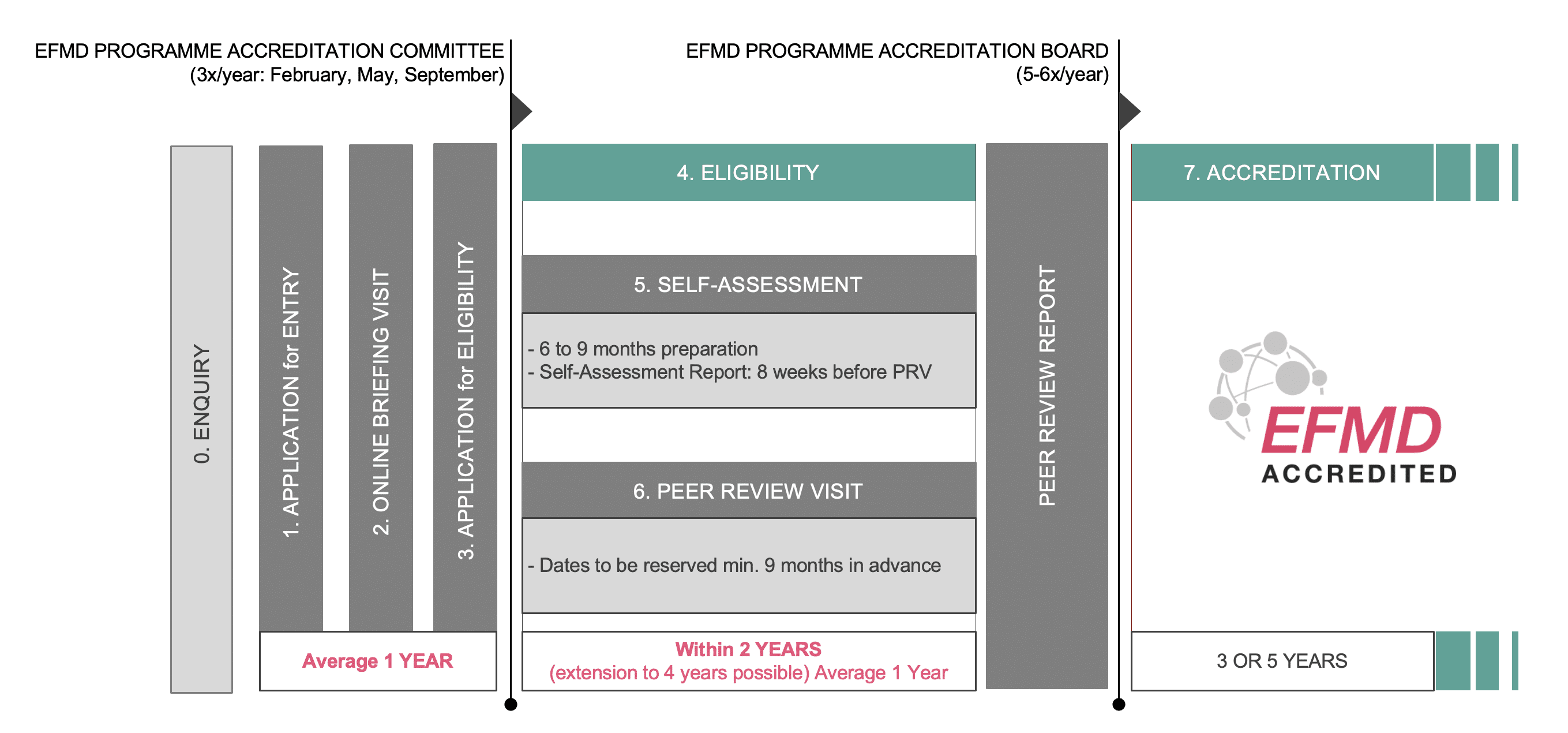
Begin with the dedicated page for EFMD Accredited on the EFMD website, where you will find detailed information and all relevant documents. The Core Documents and Eligibility Criteria will help answer many of your questions. (See flowchart example of the EFMD Programme Accreditation process below.) You may use the ‘Contact’ forms on our website to express your interest and get in touch with our accreditation team.
Starting the accreditation process requires an enquiry and initial conversation with the EFMD Programme Accreditation Office. Following the initial conversation, the institution may be invited to complete a Draft Datasheet using EFMD’s Online Data Collection System, OX. Based on the information you provide in the Datasheet, you may be invited to start the formal process by submitting an official Application Form and hosting an Online Briefing Visit.. From the beginning, you will have a Key Account Manager who will guide you through the process.
Table 2: Example of EFMD Programme Accreditation process

Eligibility requirements
Eligibility requirements cover various areas, and your account manager will help you with this. However, some basic requirements must be met. The first requirement for all accreditation applications is to be an EFMD member in good standing. If you are not yet a member, please visit our website to begin that process. A second basic requirement is that your institution needs to be in operation for at least five years to apply for EFMD programme accreditation.
EFMD Accredited requires that the programme has been producing graduates for at least two cohorts with a minimum aggregate of 30 graduates from the programme in the two years prior to the date of your accreditation application. There should be a minimum cohort size of 20 students for all programmes for each mode of delivery and intake. Additional requirements are covered in the Eligibility Criteria documents available on the dedicated page for EFMD Accredited on the EFMD website.
How long does accreditation take?
The average duration of the process, from initial enquiry to the accreditation decision, is typically 2 years.
Table 3: Example of EFMD Programme Accreditation timeline
How much does accreditation cost?
You can find the EFMD Accredited Fee Schedule here.
What staffing resources does an institution need to ensure a smooth and efficient process?
Management of an accreditation process should be aligned with the school’s strategic objectives and organisational structure. It typically involves an academic lead and an accreditation manager to ensure a seamless accreditation process. In addition to those basic resources, involvement in the accreditation process from the whole school is crucial.
Should our institution get our flagship programme EFMD Accredited before applying for EQUIS?
It is not required that a school holds an EFMD programme accreditation before applying to EQUIS. However, a programme accreditation can be a beneficial stepping stone to achieving EQUIS accreditation.
It can also be maintained in case of successful completion of the EQUIS accreditation process and a further differentiation point.
What if I don’t meet the eligibility requirements yet?
If you do not yet meet the eligibility requirements for accreditation, you can start by going through the membership process. We then have several other assessment options to help you work towards your goal:
EFMD Deans Across Frontiers (EDAF): EDAF is a unique quality improvement system that assists your business school in further development through mentoring of your senior management team. EDAF offers your school assistance in development, consultancy, and mentoring by an experienced Dean or former Dean through a flexible system that takes into account the diversity of institutional models, countries, and cultures. All of this will help your institution strive towards excellence and be more impactful in the management development community.
Business School Impact System (BSIS): BSIS is designed to determine the extent of a school’s impact on its local environment – the city or region in which it is located. The BSIS process is offered in collaboration between EFMD Global and FNEGE as a service to EFMD members worldwide. The impact of the business school is analysed based on the following seven areas of impact: financial, educational, business development impact, as well as intellectual, societal, image, and impact within the regional ecosystem.